Chemistry You Cannot Burn Your Way Out Of
Process emissions · June 24, 2026 · 10 min read
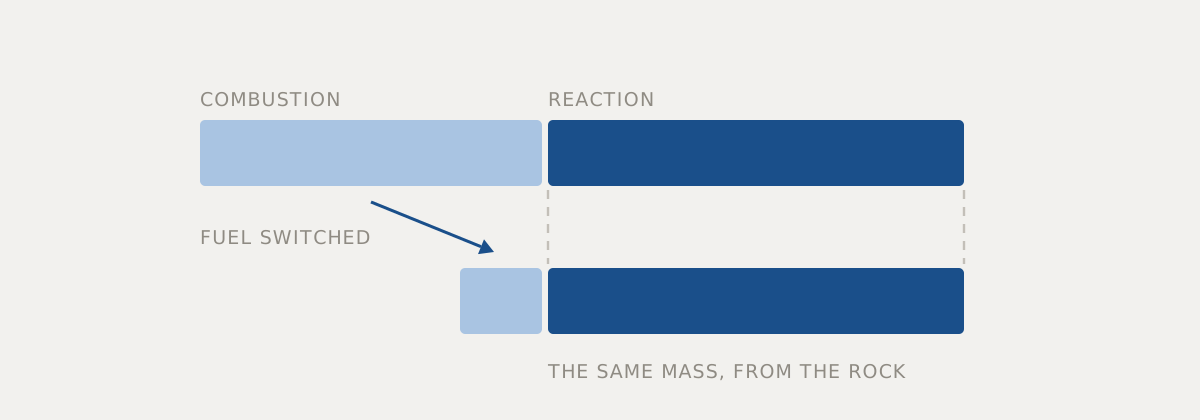
Switch the fuel under a boiler and the emissions attached to that boiler change in proportion. Switch the fuel under a cement kiln and a large share of its carbon dioxide carries on regardless, because that share was never produced by combustion in the first place. It came out of the limestone.
This distinction is the reason cement, lime, steel, glass, ammonia and aluminium are grouped as hard to abate while sectors with similar energy intensity are not. It is not that their furnaces are hotter or their engineers less capable. It is that carbon appears in the stoichiometry of what they make, and stoichiometry does not negotiate with a fuel contract.
Cement: the carbon dioxide is in the raw material
Clinker, the reactive component of ordinary cement, is made by heating a limestone-based raw mix until the calcium carbonate decomposes. Calcium carbonate becomes calcium oxide and carbon dioxide. The carbon dioxide leaves through the stack.
Two properties of that reaction determine everything downstream. It is endothermic, so it consumes fuel — and that fuel’s emissions are ordinary combustion emissions, addressable by any of the usual means. And it is stoichiometric: a fixed mass of carbon dioxide is released per unit of calcium oxide produced, fixed by molar masses, identical in every kiln ever built and every kiln that ever will be. No burner, no waste-derived fuel, no efficiency programme touches it.
Which leaves exactly three levers, and it is worth being clear that they are the only three.
Use less clinker per unit of cement. Cement is clinker plus other materials that contribute to strength or fill space. Raising the proportion of supplementary materials — calcined clays, ground slags, ashes, limestone filler — lowers the clinker factor and lowers process emissions proportionally. This is the lever with the least new technology in it and the most standards work, because concrete performance is specified by prescription in many markets rather than by outcome, and a binder that performs adequately can still be inadmissible.
Use a chemistry that does not start from a carbonate. Alternative binders exist that derive their reactive calcium or their strength mechanism from something other than decomposed limestone. The barriers here are supply of the input minerals at scale, durability evidence measured in decades for structures designed for decades, and the same specification problem in a harder form.
Capture the carbon dioxide. The gas released by calcination is comparatively concentrated where it can be kept apart from the combustion exhaust, and separation cost rises steeply as a stream becomes dilute. That is why kiln configurations that separate process gas from combustion gas, or that burn in oxygen instead of air, are interesting for reasons that have nothing to do with the fuel and everything to do with what capture costs afterwards.
Steel: the carbon is doing chemistry
Iron arrives as oxide. Making metal from it means taking the oxygen away, and taking oxygen away requires something that wants it more than the iron does. The conventional answer is carbon, via carbon monoxide, and the product of that reaction is carbon dioxide by definition. Not as waste, not as inefficiency — as the intended output of the intended reaction.
This is why efficiency work in a blast furnace has a floor. You can approach the thermodynamic minimum quantity of reductant and you cannot go below it, because below it the ore does not reduce.
So again the levers are structural rather than operational.
Change the reductant. Hydrogen reduces iron oxide and produces water. The process route differs from the blast furnace — direct reduction produces a solid metallic product that is then melted, rather than liquid iron — and the demand shifts from coking coal to enormous quantities of hydrogen and electricity. The emissions question then migrates entirely to how that hydrogen was made, which is a different essay’s worth of accounting.
Skip reduction. Scrap steel is already reduced. Melting it in an electric arc furnace bypasses the chemistry altogether, which is why scrap-based production has a fundamentally different emissions profile. The limit is not technology but supply and quality. Available scrap is a function of what was built decades ago and is being demolished now, so the pool grows slowly and is bounded by history. And scrap carries residual elements — copper from wiring and motors is the standard example — that do not oxidise out in refining the way carbon and silicon do. They accumulate. Some product grades tolerate them, some do not, and dilution with primary metal is the usual remedy, which puts a ceiling on how much of the market a purely circular route can serve.
Capture. Same as everywhere: technically available, economically dependent on stream concentration, and dependent on somewhere to put the product.
The same pattern elsewhere
Lime is calcination with the clinkering step removed, so the process share of its emissions is higher still. Glass batches contain carbonates that decompose in the furnace. Ammonia synthesis needs hydrogen, and where that hydrogen comes from reforming natural gas the carbon dioxide is a co-product of making the hydrogen rather than of burning anything — usefully, as a concentrated stream already separated in some plants for other reasons. Primary aluminium consumes carbon anodes in the reduction reaction itself.
The pattern is consistent: wherever carbon appears in the reaction rather than in the flame, energy policy aimed at fuels passes straight through the sector without touching the largest part of the problem.
Why this reorders a decarbonisation plan
A site that measures progress in energy intensity can improve every year and watch its total emissions barely move. The energy metric is not wrong; it is measuring the addressable half. Any target that will eventually be audited against absolute emissions needs the process component broken out from the start, because the two components respond to entirely different interventions on entirely different timescales.
There is a compensating advantage, and it is underrated. Process emissions are usually calculable by mass balance from what went into the kiln and what came out, and stoichiometry is exact in a way that fuel emission factors are not. A site that knows its raw mix and its production tonnage can compute its process emissions with less uncertainty than it can compute its combustion emissions. The number is more defensible, not less — which is why any estimate worth trusting keeps the two on separate lines rather than merging them into one comfortable total.
A closing caution about utilisation
Capture is the residual answer wherever the chemistry cannot be changed, and “utilisation” is the word attached to the hope that the captured gas becomes a product rather than a liability.
The accounting question is residence time. Carbon dioxide mineralised into a durable solid is bound for as long as the solid exists. Carbon dioxide converted into a fuel is released when the fuel is burned, which makes the process a delay and possibly a fossil-carbon reuse, not a removal. Carbon dioxide sold for carbonating a drink leaves the building faster than the invoice. All three are sometimes described with the same word, and the only way to tell them apart is to ask how long the carbon stays put and whether it was fossil or atmospheric when it started.