What Gets Counted, and by Whom
Carbon accounting · July 9, 2026 · 10 min read
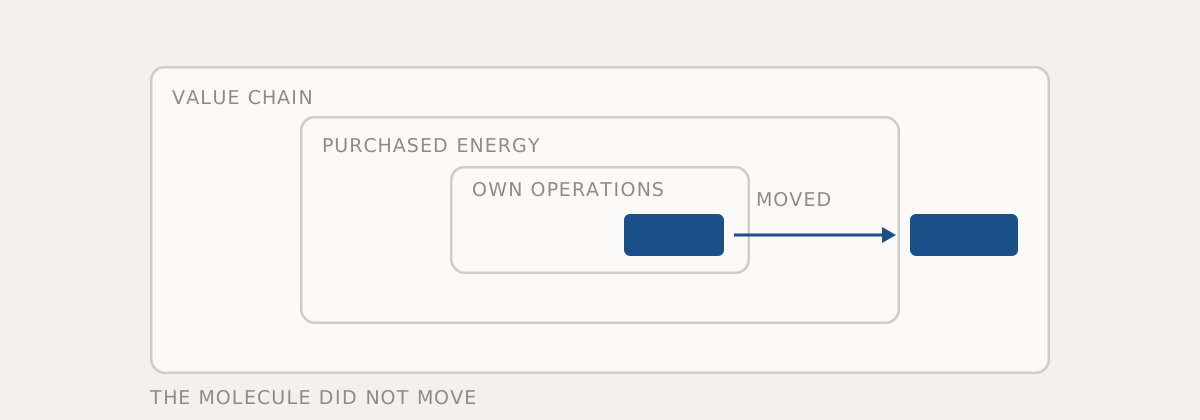
Corporate carbon accounting is often introduced as measurement. It is closer to consolidation accounting: a set of conventions for deciding which physical events belong on whose report, applied to a world where the same molecule is legitimately counted several times.
That last point is the one that unlocks everything else. A tonne of carbon dioxide from a supplier’s furnace appears in the supplier’s scope 1 and in the customer’s scope 3. This is not double counting in the sense of an error; the scheme was designed to let each organisation see the emissions it can influence, and influence overlaps. It does mean that a corporate inventory cannot be added up across companies to get a national total, and that changes to a number can come from three quite different places: less was burned, the boundary moved, or the factor changed.
Only the first is abatement. The other two are worth learning to spot.
Outsourcing is a boundary move
Sell the captive power plant and buy the same steam back over the fence. Stop making clinker and start buying it. Contract out a drying step to a specialist.
In every case scope 1 falls, scope 3 rises, and the physical world is unchanged except for the transport. The reported improvement is real as an accounting fact and empty as an abatement fact, and there is no way to distinguish the two from a scope 1 figure alone. The tell is a step change with no corresponding capital project, and the check is whether total reported emissions across all scopes moved in the same direction.
It is also why targets set on scope 1 and 2 alone create a quiet incentive to restructure rather than to abate, and why a credible target covers the categories where the emissions actually live — usually the hardest ones to measure.
The organisational boundary is a choice with three settings
Before any emission is classified, an organisation decides which entities it is reporting for. The usual conventions are equity share, financial control and operational control, and joint ventures, leased assets and minority holdings land differently under each.
A company with a half-owned smelter reports half of it under equity share and possibly none of it under operational control. Neither is wrong. But the convention has to be stated, applied to everything, and held constant, because switching conventions rewrites history in a direction the switcher chose.
Scope 2 has two answers on purpose
Electricity is reported twice under the standard dual approach, and the two numbers measure different things.
The location-based figure uses an emission factor for the grid where the consumption physically happened. It answers: given what the wires around this plant actually carry, what did this load cause?
The market-based figure uses the emission factor attached to whatever contractual instruments the buyer holds — supplier-specific rates, certificates, power purchase agreements. It answers: what has this organisation contracted for?
Both are legitimate; only one of them changes the moment a contract is signed, with no change in what the substation delivers. That is not a reason to dismiss market-based reporting — procurement genuinely funds generation — but it is a reason to interrogate three properties of any such claim. Does the contracted generation exist because of this purchase, or would it have been built anyway? Is it on the same grid the load sits on, so the electrons could in principle have arrived? And is the matching annual, or does it hold at the hours the plant is actually consuming? A certificate bought for a sunny quarter in another region does not make a night shift clean.
The honest presentation is both numbers, side by side, always.
Spend-based scope 3 has a perverse gradient
Most organisations begin scope 3 with spend-based estimation: multiply money paid to a category of supplier by a factor expressing emissions per unit of spend. It is a reasonable way to find out where to look, and it is a terrible way to measure progress, because of what it implies about incentives.
Under a spend-based method, a supplier who halves their emissions changes your reported number not at all. What changes your reported number is paying them less — by negotiating harder, by switching to a cheaper supplier, or by buying less. The metric rewards procurement savings and is blind to the actual objective.
Moving to activity-based data — quantities of material, kilometres of freight, units of product, each with a physical factor — removes that gradient. Moving to supplier-specific data removes it and improves accuracy. Both require information the reporting organisation does not own, which is the real reason so many inventories remain spend-based years after everyone involved has understood the problem.
Baselines get restated, and that is where targets soften
A percentage reduction is measured against a baseline year, and baselines are recalculated when the organisation acquires, divests, changes method or discovers an error. Recalculation is not merely legitimate, it is required — otherwise buying a company would look like a failure and selling one like a triumph.
But it is also the single easiest place for a target to become easier without anyone saying so. The questions that make it visible are simple and rarely asked: has the baseline been restated since the target was set, in which direction, and for what stated reason? A recalculation policy fixed in advance and applied mechanically is the difference between an adjustment and a convenience.
Four more places numbers move without abating
Biogenic carbon is conventionally reported separately from fossil carbon rather than inside the main total. Whether that is appropriate depends on the source and on how long the biomass takes to regrow — and an aggressive interpretation can move a large quantity of stack emissions into a memo line.
Avoided emissions — the claim that a product reduces emissions elsewhere — are not a subtraction from an inventory. They can be a genuine and important argument about a company’s contribution, and they belong outside the balance, because the counterfactual is unverifiable and the emissions were never yours to subtract.
Offsets and removals sit outside the inventory as well under most conventions, disclosed alongside gross emissions rather than netted into them. An organisation reporting only a net figure has made the one adjustment that makes reductions and purchases indistinguishable.
Intensity targets divide emissions by production, revenue or floor area. Intensity can fall steadily while absolute emissions rise, if output grows faster. Both metrics are meaningful — intensity for whether the process is improving, absolute for whether the atmosphere notices — and reporting only one of them chooses which question the reader is allowed to ask.
What a defensible number looks like
Every emissions figure is ultimately a claim of the form quantity times factor, summed. That makes the audit surface small and specific.
State the boundary and the consolidation convention. State each factor, its source document and its edition, because factors are revised. Keep activity data traceable to a meter, an invoice or a weighbridge ticket. Separate combustion from process emissions, since they are derived by different methods with different uncertainties. Report gross before net, and both scope 2 methods. Say what is measured, what is calculated and what is estimated.
None of that is difficult. It is merely the difference between a number someone can check and a number someone has to trust.