Where Electrification Runs Out of Temperature
Industrial heat · June 5, 2026 · 9 min read
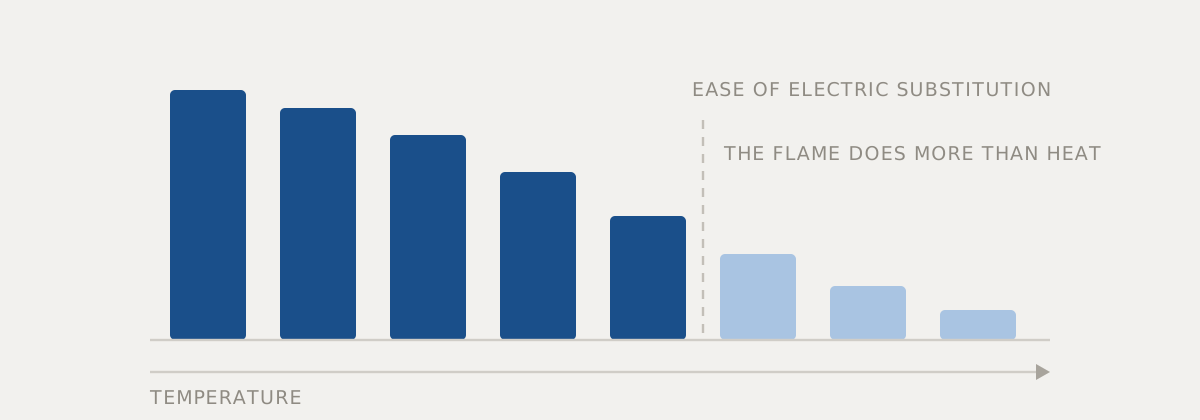
Start with the claim that gets repeated until it sounds like physics: electric heating works below some temperature and fails above it. It is not true in the form it is usually stated. Induction, arc, plasma, resistance and electron beam between them reach anything a flame reaches and then some. Metals are melted electrically every day.
The ceiling is real, but it sits somewhere else. It is not about how hot the element can get. It is about how heat arrives at the material, what else the burner was doing while it was heating, and what the substitution costs per unit of delivered heat once the meter is read rather than the invoice.
Three regimes, not one problem
Industrial heat demand is usually discussed as a single quantity, which hides the only thing that matters about it. Sort the same demand by temperature and three different technical situations appear, with different economics and different answers.
Below the boiling range of water and a little above it — washing, drying, pasteurising, evaporating, space and process hot water — a heat pump moves heat rather than making it. Because it is moving rather than converting, it delivers more heat than the electricity it consumes. That is the only regime where electrification is thermodynamically cheaper in energy terms than burning something, and it is the regime where the argument is essentially settled apart from capital cost and integration work.
The constraint here is the lift: the temperature gap between the source the pump draws from and the sink it delivers to. Efficiency falls as the lift widens, which means the interesting engineering is not in the machine but in finding a warm source. A site rejecting heat from a compressor, a condenser or a flue, at a temperature nobody has bothered to look at, is the reason the same heat pump can be excellent in one plant and marginal in the next.
In the middle band — steam-raising, curing, calcining at modest temperatures, many chemical duties — resistance heating and electric boilers work perfectly well, and offer no thermodynamic advantage at all. One unit of electricity becomes one unit of heat. The switch is therefore governed almost entirely by the ratio of the electricity price to the fuel price at the site boundary. Where that ratio is wide, electrification means paying several times over for the same joule, and no amount of enthusiasm changes the sum.
At the top — melting, smelting, clinkering, glass, high-temperature reforming — the flame is not merely a source of heat. It is part of the process geometry.
What the flame was doing besides heating
This is the part that survives every price assumption, so it is the part worth understanding.
A luminous flame radiates. Radiative transfer is what moves large quantities of heat into a large load quickly, and it does so from a hot gas that fills the space above and around the material. In a rotary kiln, combustion gases travel the length of the tube counter to the material, heating it progressively while the tube turns; the flame is simultaneously the heat source, the transfer medium and part of the residence-time design. Swap in a resistive element and you have not changed a component, you have changed the heat path — and with it the length, the refractory, the gas handling and the throughput.
Combustion also sets the atmosphere. Some processes need reducing conditions, some need oxidising, some need particular gas compositions in contact with the load; that atmosphere is a product of what is burned and how much air comes with it. An electric heater supplies no atmosphere, which is sometimes an advantage and sometimes a specification you now have to meet another way.
And combustion supplies power density trivially. Burning more fuel per second in the same space is a matter of a valve. Delivering the same power electrically is a matter of conductors, transformers, switchgear and a grid connection — which is frequently the binding constraint. The honest question at many sites is not whether an electric furnace exists but whether the substation can feed it this decade.
The efficiency comparison that misleads
Electrification arguments are often settled with a number that compares the wrong things: the thermal efficiency of the furnace against the electrical efficiency of the heater. At the point of use, electric heating looks excellent. Read one boundary further out and the comparison depends entirely on how the electricity was generated, which is regional, which changes annually, and which is precisely why nobody should be handed a single figure for it.
There are two separate questions and they get conflated constantly. Does this change reduce energy consumption? — a site question, answerable with a meter. Does this change reduce emissions? — a question that cannot be answered without an emission factor for the electricity, and the answer can be negative in a fossil-heavy region and strongly positive in a clean one for identical equipment. Anyone quoting a universal answer has substituted their grid for yours.
The same trap operates in reverse on hydrogen and other substitute fuels, where the relevant boundary is how the fuel was made rather than what comes out of the stack.
A sequence that usually beats a substitution
The frustrating property of high-temperature electrification is that it is a capital decision on equipment that is replaced rarely. The measures that are available continuously get skipped in favour of the one that cannot happen until the next rebuild.
Recover the heat first. Every unit of heat retrieved from an exhaust, a cooling stage or a hot product is a unit that never has to be made, by any technology, at any price. Recovery also shrinks whatever comes next: a smaller electrical duty is a smaller connection, a smaller capital cost and a shorter queue.
Then match temperature to duty. Burning a high-grade fuel to produce low-grade heat, on a site that is simultaneously rejecting heat at that same grade, is common enough to be worth checking before anything else. Steam distributed at one pressure for the convenience of a single high-temperature user is the usual mechanism.
Then substitute, starting where the substitution is a swap rather than a redesign — the heat-pump band first, the middle band where the price ratio allows, the top band at the rebuild.
What the ceiling actually is
Stated properly: electrification stops where the burner is doing work that an element cannot do without rebuilding the process around it, and where the electricity to replace it cannot be delivered at the required rate at a price the product can carry.
That is not a temperature. It is a configuration and a connection. Which is why the boundary moves — plant by plant, region by region, and year by year as grids change and equipment is designed for electric delivery from the start rather than adapted to it. Anyone who tells you where the line sits without asking about your kiln geometry, your atmosphere requirement, your substation and your tariff is telling you about their own site, not yours.