Thirty-Year Assets, Ten-Year Decisions
Capital economics · July 28, 2026 · 10 min read
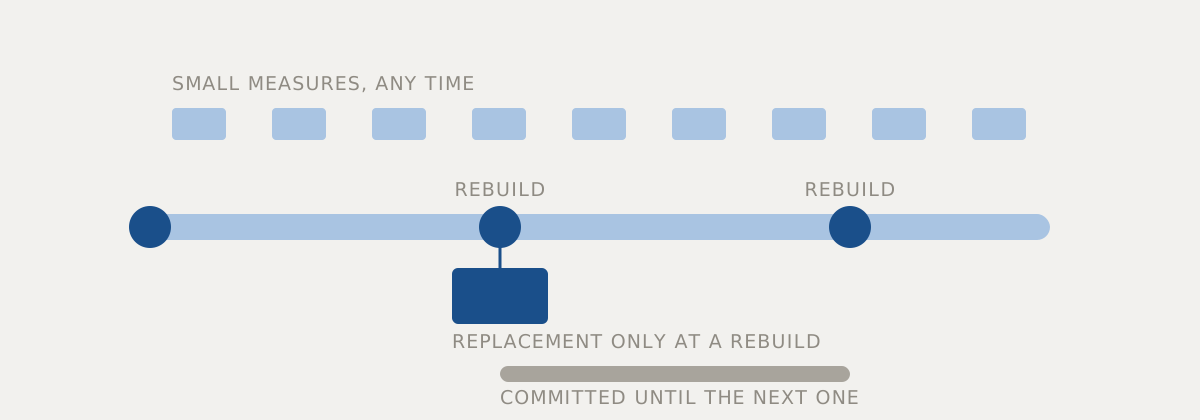
A furnace does not care what year it is. It is relined when the refractory is spent, rebuilt when the shell is done, and replaced when the whole line no longer earns its keep. Those events are rare, they are scheduled by condition rather than by intention, and between them the capital is committed.
Everything awkward about industrial decarbonisation economics follows from that. The opportunity set available in any given year is not the set of technologies that exist; it is the much smaller set of assets that happen to be near a decision point, crossed with the technologies mature enough to specify at that moment. A plan that ignores the maintenance calendar is a plan to either write off working equipment or to do nothing while waiting.
Remaining life, not nominal life
The most common error in evaluating a retrofit is to appraise it over its own lifetime rather than over the host asset’s remaining lifetime.
A heat recovery package with a payback period shorter than its own design life looks attractive in isolation. Fit it to a kiln scheduled for replacement before that payback completes and it never pays back at all — the savings stop when the kiln does. The correct horizon is whichever is shorter: the measure’s life, or the remaining life of the thing it is bolted to.
This cuts both ways, and the favourable direction is usually neglected. A measure fitted just after a major rebuild has an entire cycle ahead of it, so the package that fails on an old line passes comfortably on a young one. Sequence the retrofit programme against the asset register’s condition data, not against a list ranked by payback in the abstract.
Replacement carries an accounting penalty that cash flow does not show
Replacing equipment that still functions means disposing of an asset with book value remaining. The cash economics may be excellent; the write-off still lands in the income statement in the year of the decision, and it lands on whoever signed for it.
It is easy to treat this as an irrationality to be argued away. It is more useful to treat it as a constraint that predicts behaviour reliably: early replacement is harder to approve than its net present value implies, and the difficulty scales with how much unamortised value remains. What works is arranging around it — timing decisions to coincide with the end of a depreciation schedule, or structuring the transaction so the equipment sits on someone else’s balance sheet.
Abatement cost curves hide the two things that matter
The standard planning artefact ranks measures by cost per tonne abated and presents them as a staircase. It is a useful communication device and a dangerous planning device, for two reasons that are structural rather than correctable by better inputs.
Measures interact, so the ordering changes the costs. Recover waste heat first and the burner you were going to electrify is smaller, so the electrification project costs less and abates less — both of its coordinates move. Electrify first and the heat recovery has less to recover. The curve displays independent bars for measures that are not independent, and the totals along the bottom axis are not additive in the way the picture invites.
It is computed at a price vector that will not hold. Fuel prices, electricity prices, carbon prices and equipment costs all appear in every cost per tonne on the chart. A curve is therefore a snapshot conditional on a forecast, and the ranking it produces is stable only where the gaps between measures are wider than the forecast error. They usually are not.
Neither objection means abandon the analysis. They mean run it as a comparison of sequences under several price paths, rather than as a queue to be worked down in order.
Waiting has value, and so does not foreclosing
Two options are in play at every decision point and they pull in opposite directions.
Deferring has value when technology is improving and prices are uncertain, which is the normal condition here: equipment specified after the next rebuild will be better and probably cheaper than the same equipment specified now.
But acting also preserves value, because rebuilding the same configuration now removes the option to do anything different until the next cycle. A conventional rebuild is not a neutral delay; it is a commitment with a long tail, and it is frequently made by default because the alternative was not ready on the date the refractory failed.
So the question at a rebuild is not only “does the low-carbon option pay today?” but “what does this decision do to the choice set fifteen years from now?” — and those have different answers often enough to be worth asking separately.
Design for the conversion you are not making yet
This is where the two options above reconcile, and it is the most useful thing in the whole discussion.
Most of the cost of a future conversion is not the new equipment. It is the space it needs, the electrical capacity to feed it, the foundations to carry it, the tie-in points for gas handling, the outage required to fit it and the production lost during that outage. Nearly all of those can be provided during a rebuild that is happening anyway, at a small fraction of what they cost as a standalone project later.
Leave the footprint. Size the transformer and the incoming connection for a load you do not yet have. Route the ducting so a capture train can be tied in without cutting the shell. Specify the foundation for the heavier machine. Choose the layout that allows a module to be added rather than the tightest one that fits today.
This converts an expensive irreversible decision into a cheap reversible one. It also survives being wrong: if the anticipated technology never arrives, the site has spent a modest sum on space and capacity, which are the two things heavy plants always end up wanting anyway.
The hurdle rate does more work than any engineering parameter
Efficiency and abatement projects are usually appraised against an internal hurdle rate, and at many industrial firms that rate sits well above the cost of capital.
The reason is capital rationing rather than confusion. Efficiency projects compete for the same budget as capacity expansion, and expansion projects promise revenue rather than cost avoidance. A high hurdle is a crude but functional way of triaging a queue that is longer than the budget.
The consequence is that a large set of projects with genuinely attractive returns goes unfunded year after year, and no amount of improving the business case fixes it, because the case was never the binding constraint. The interventions that do work are structural: a ring-fenced budget line that does not compete with production capacity, a different approval threshold for measures below a certain size, or third-party financing that moves the expenditure off the capital budget entirely.
Which is a slightly deflating conclusion for an engineering discipline. The decisive variable in most industrial abatement decisions is not the technology, the fuel price or the carbon price. It is where the project sits in someone’s capital queue, and on what date the plant was next going to be opened up anyway.